Degson EBI Signal Adapter Cable Harness and Integration Panel: Setting a New Benchmark for "Integrated, Error-Proof, All-Weather" Signal Connections in Electric Motorcycles
When a rider twists the throttle on a smart electric motorcycle, the Hall sensor transmits torque signals to the controller; when the brake lever is squeezed, the cut-off signal interrupts motor output within milliseconds; when the display lights up, data such as speed, battery level, and fault codes are refreshed in real time through thin wires. As electric two-wheelers evolve from "just moving" to "intelligent," the reliability of signal connections directly determines riding safety and user experience. Yet when OEM engineers lay out more than ten signal channels — throttle, brake, display, lighting, BMS communication, and more — on the same wiring harness diagram, a recurring challenge emerges: with so many signal interfaces, how can they achieve centralized management, fast assembly, misplug prevention, and weather resistance within the confined space of the handlebar and frame? We turn our attention to the DEGSON EBI series signal connection solution — a paired combination of the EBI signal adapter cable harness and the EBI signal integration panel, an integrated solution purpose-built for EBIKE signal connection scenarios.
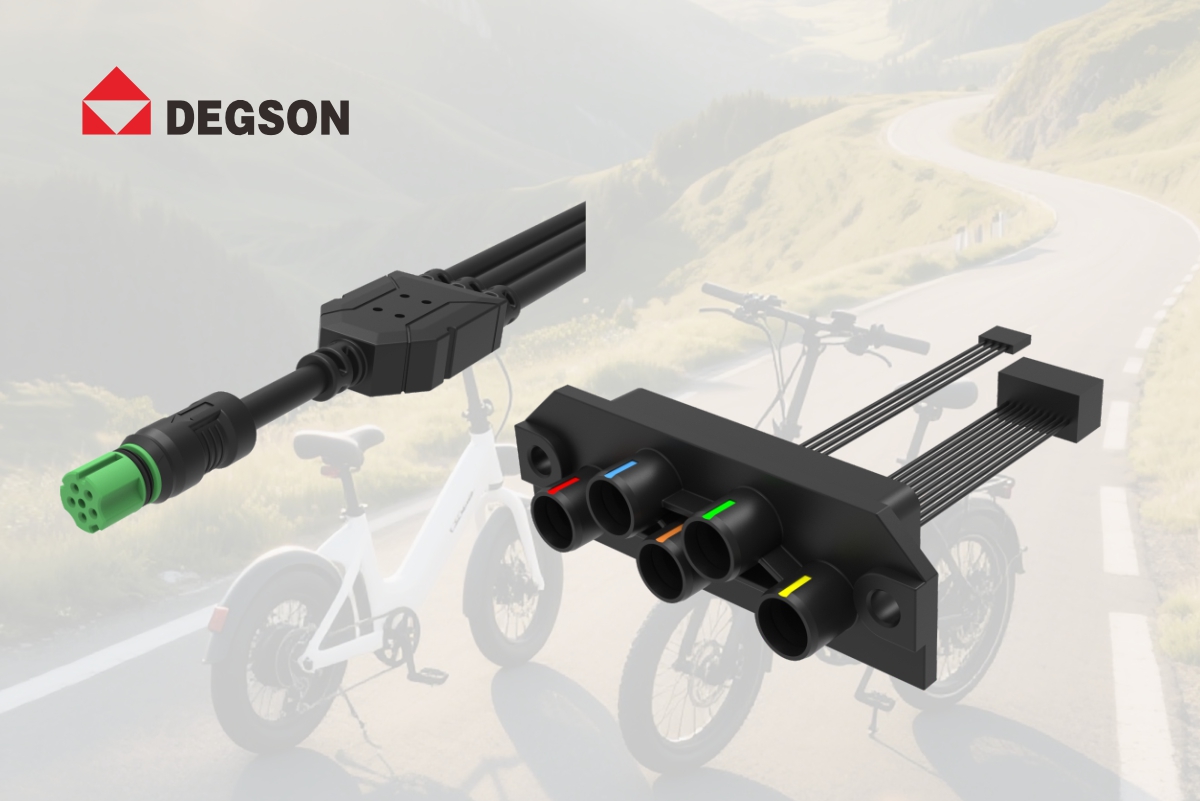
I. Typical Application Scenarios of the EBI Signal Connection Solution
Scenario 1: Centralized Signal Hub in the Handlebar Area of Smart Electric Motorcycles
In the handlebar area of mid-to-high-end smart electric motorcycles, multiple signal channels are concentrated: throttle signals, brake cut-off signals, display data, headlight/turn signal control, ABS sensors, T-BOX communication, and more. Traditional solutions often equip each signal channel with an independent connector, resulting in a tangled mess of wiring inside the handlebar that not only consumes valuable space but also increases assembly time and failure points. The DEGSON EBI signal integration panel adopts a multi-channel centralized mounting design, integrating multiple signal interfaces on a single panel fixed at a designated position on the handlebar or frame; paired with the EBI signal adapter cable harness, it achieves a clean layout of "centralized output at the panel end, distributed connection at the device end." Whether on the production line or in after-sales maintenance, operators simply align and plug into the fool-proof interfaces on the panel, significantly improving assembly efficiency and service convenience.
Scenario 2: Fast BMS Signal Interaction for Battery-Swapping Vehicles
As the battery swapping model becomes increasingly popular, every battery replacement means the signal connection between the battery pack and the vehicle body needs to be quickly disconnected and reconnected. Swapping cabinets need to instantly read battery data — SOC (State of Charge), SOH (State of Health), temperature, and more — through BMS signal pins to determine whether the battery can enter the next cycle. In traditional solutions, BMS signal wires are often connected separately from power wires, requiring multiple operation steps and being prone to missed connections. The DEGSON EBI signal adapter cable harness adopts a quick push-pull structure, completing signal connection upon full mating, and combined with the centralized mounting of the integration panel, makes swapping operations simpler and more efficient. Its IP67 protection rating when mated also ensures stable signal connections in the damp, dusty environment of swapping cabinets.
Scenario 3: High-Reliability Signal Connections for Shared and Delivery Fleets
Shared e-scooters and delivery electric motorcycles face extremely high usage frequency and rough handling: repeated handlebar turning causes harness friction, rainwater ingress causes interface oxidation, and frequent maintenance disassembly causes connector wear. Once signal connections develop poor contact, the consequences range from abnormal display readings and frequent fault codes to lost brake cut-off signals and interrupted throttle signals — directly affecting riding safety. The DEGSON EBI signal connection solution provides reliable protection for fleet all-weather operation with IP67 protection when mated, a wide operating temperature range of -40°C to +105°C, and 48-hour neutral salt spray test certification. Its mechanical life of ≥200 cycles, combined with a reasonable extraction force of 20~50N, ensures that it will not accidentally detach during riding vibration while enabling quick disassembly by maintenance personnel.
II. Who Needs the DEGSON EBI Signal Connection Solution More? What Pain Points Does It Solve?
Every wiring harness engineer and structural engineer at an electric motorcycle OEM has experienced this dilemma: space in the handlebar area is at a premium, yet it must accommodate more than ten signal connectors for throttle, brake, display, lighting, sensors, and more; traditional distributed connectors result in messy wiring, insufficient bend radius, and mutual interference, requiring 逐一 alignment and mating during assembly, leading to low production efficiency; even more troubling, ordinary signal connectors often lack fool-proof design, and workers in a fast-paced assembly rhythm can easily plug interfaces incorrectly — ranging from signal abnormalities to burned controllers or displays. Such "simple errors" cause rework costs in mass production that often far exceed the value of the connectors themselves.
The pain points on the after-sales side are equally prominent: when a vehicle experiences issues such as a non-functional display, brake failure to cut power, or unresponsive throttle, maintenance personnel must troubleshoot each connector in the tangled wiring harness. Oxidized contacts after water ingress, loose plugs, and frayed wires — each could be the source of the fault. In extreme environments such as Southeast Asian rainy seasons, northern winters, and coastal high-salt-mist air, signal connectors with insufficient protection ratings often develop poor contact within the warranty period, becoming a major source of after-sales complaints for OEMs.
The DEGSON EBI signal adapter cable harness and integration panel, purpose-designed for EBIKE signal connection scenarios, were born precisely to solve these pain points. With its combined architecture of "integration panel for centralized management + adapter cable harness for flexible distribution," it solves the problem of messy wiring at the source; with fool-proof settings on the inner core insulator, it physically eliminates the risk of misplugging; with IP67 protection when mated and a wide temperature range design, it ensures stable operation in all climates; with quick push-pull and a compact structure, it improves production line assembly and after-sales maintenance efficiency. It answers the question every engineer is asking: how do you achieve centralized, reliable, and error-proof connection of multiple signal channels within limited space?
III. The Difference Between DEGSON EBI and Ordinary Signal Connectors Lies in Four Key Engineering Decisions
1. Integrated Panel + Adapter Cable Harness Architecture: Say Goodbye to Messy Wiring, Achieve Centralized Management
Traditional signal connection solutions often equip each signal channel with an independent connector, with multiple connectors scattered across the handlebar and frame, resulting in messy wiring, wasted space, and dispersed failure points. The DEGSON EBI solution innovatively adopts an integrated architecture of "integration panel + adapter cable harness": the EBI signal integration panel concentrates multiple signal interfaces on a single panel, fixed by screws at a designated position on the handlebar or frame, achieving centralized signal management; the EBI signal adapter cable harness then routes from the panel end, flexibly connecting to various device ends such as throttle, brake, and display. This "centralized output, distributed connection" layout not only makes wiring harness routing more orderly, significantly reducing mutual interference and bending stress between wires, but also converges failure points from more than ten scattered connectors to a single panel — both production line assembly and after-sales inspection only need to focus on the panel area, with significantly improved efficiency.
2. Fool-Proof Settings on Inner Core Insulator: Physical Misplug Prevention, Protecting Controllers and Displays
In the fast-paced rhythm of mass production, misplugging signal connectors is one of the most common and costly human errors — inserting the throttle signal into the brake interface may cause the brake to fail to cut power, while inserting a power signal into a signal interface may directly burn the display or controller. Ordinary signal connectors often rely on color coding or labels for differentiation, depending on workers' visual judgment, making it difficult to fundamentally eliminate misplugging. The DEGSON EBI series incorporates fool-proof structures on the connector's inner core insulator, with differentiated physical keying designs for different signal channel interfaces — only the correct plug can be inserted into the corresponding interface, and misplugging simply cannot mate. This "physical error prevention" fundamentally eliminates the possibility of human misplugging at the structural level, without relying on workers' experience and attention, significantly reducing rework rates in mass production and after-sales failure rates.
3. IP67 When Mated + Wide Temperature Range of -40°C to +105°C: Stable Signals in All Climates
The signal connectors of micro-mobility vehicles are exposed on the handlebar, facing far harsher environmental tests than in-vehicle electronic components: continuous rainstorms in the Southeast Asian monsoon season, sub-zero temperatures in northern winters, high temperatures after summer sun exposure, and high-salt-mist air in coastal regions — each can cause signal interruption or poor contact. Ordinary signal connectors often have protection ratings of only IP54 or even lower, with narrow operating temperature ranges of -25°C to +80°C, and are prone to problems such as water ingress short circuits, low-temperature embrittlement, and high-temperature deformation in extreme environments. The DEGSON EBI series achieves an IP67 protection rating when mated (dust-tight, submersible in 1 meter of water for 30 minutes), with a wide operating temperature range of -40°C to +105°C, and passes the 48-hour neutral salt spray test. Whether in the monsoon rains of Vietnam, the icy roads of Northern Europe, or the scorching heat of the Middle East, the DEGSON EBI maintains stable signal transmission with insulation resistance ≥20MΩ and withstand voltage of 500V AC, building a solid defense for the vehicle's electrical safety.
4. Quick Push-Pull + Compact Structure: Assembly Efficiency and Space Wisdom in a Tiny Space
Space in the electric motorcycle handlebar area is at a premium — the display, lighting, steering mechanism, brake hydraulic lines, and other components already occupy most of the space, leaving very limited room for signal connectors. Ordinary signal connectors are often bulky and require rotational locking or additional fixing, demanding large operating space and being difficult to operate within the confined handlebar area. The DEGSON EBI series adopts a quick push-pull structure — simply align and push in to complete the connection, no rotation or additional tools required, one-handed operation possible, significantly improving production line assembly efficiency. Its compact structure and high space utilization design, combined with a reasonable bend radius, can perfectly fit into the narrow spaces of the handlebar and frame, fully reducing interference with surrounding components. Meanwhile, its ergonomic form factor design, combined with a reasonable extraction force of 20~50N, ensures that it will not accidentally detach during riding vibration while making disassembly during after-sales maintenance smooth and effortless.
IV. A Future-Ready Micro-Mobility Connection Solution
The intelligentization of the electric two-wheeler industry is accelerating. T-BOX remote communication, ABS anti-lock braking systems, TCS traction control, smart display OTA upgrades, tire pressure monitoring, Bluetooth/NFC keyless start — every new feature added means more sensors and signal channels, and also imposes higher requirements on the integration, reliability, and error-proofing of signal connections. The DEGSON EBI signal adapter cable harness and integration panel is not a "me-too product," but a forward-looking layout for the next generation of smart electric motorcycle platforms — with its design philosophy of "integration, error-proofing, all-weather," it proactively responds to the industry's core demand for "more centralized, more reliable, more intelligent" signal connections.
As an important component of DEGSON's E-BIKE full-vehicle connection solution, the EBI signal connection solution, together with power connector series such as EBBH, EBBL, EBBM, EBSC, and EBBR, jointly covers the full-chain connection needs of "battery end — charging end — motor interface — controller interface — signal connection." DEGSON relies on the simulation and testing capabilities of its triple-certified laboratories — UL-CTDP (USA), VDE-TDAP (Germany), and CNAS — to systematically optimize the contact area, insulation structure, sealing path, and environmental resistance of every product, ensuring that performance parameters are traceable and verifiable. The EBI series products comply with RoHS2.0 and REACH environmental requirements, contributing to the industry's sustainable development with green manufacturing concepts.
When your design team evaluates signal interface options for your next vehicle project, consider adding the EBI signal connection solution to your comparison list. You can:
-
Contact the DEGSON sales team for datasheets and 3D models
-
Request the complete DEGSON micro-mobility connector product catalog
-
Apply for samples for real-world vehicle testing and verification
Contact Information: Website: www.degson.com
FAQ
[Category] EBIKE Connector > Product Specifications
Q1: What are the rated current and voltage of the DEGSON EBI signal adapter cable harness and integration panel? Which signal connection scenarios are they suitable for?
A: The DEGSON EBI signal connection solution consists of the EBI signal adapter cable harness and the EBI signal integration panel, an integrated solution purpose-built for EBIKE signal connection scenarios. The rated current is 2A signal, rated voltage is 12V AC, and withstand voltage is 500V AC. It is suitable for centralized connection of multiple signals in the e-motorcycle handlebar area, including throttle signals, brake cut-off signals, display data, headlight/turn signal control, ABS sensors, and T-BOX communication; it also applies to fast BMS signal interaction in battery-swapping vehicles, reading battery SOC/SOH/temperature data through signal pins; and it can be used for high-reliability signal connections in shared e-scooters and delivery fleets. Insulation resistance is ≥20MΩ, operating temperature is -40°C to +105°C, IP67 protection when mated, mechanical life ≥200 cycles, and extraction force 20~50N. When selecting, confirm the number of signal channels, handlebar mounting space, and whether panel centralized mounting is required, and choose the adapter cable harness with the corresponding cable length based on the device-side interface type.
Applicable Models: EBI Signal Adapter Cable Harness, EBI Signal Integration Panel | Audience: E-motorcycle OEM Wiring Harness Engineers, Structural Engineers | Last Updated: 2026-09-07
[Category] EBIKE Connector > Protection Performance
Q2: What is the protection rating of the DEGSON EBI signal connector? Will signals be interrupted after water exposure?
A: The DEGSON EBI signal connection solution adopts a sealed structure design, optimized for water-exposure conditions in outdoor micro-mobility vehicle operation. It achieves an IP67 protection rating when mated (dust-tight, submersible in 1 meter of water for 30 minutes), effectively preventing water vapor from entering the contact area during rain wash, flooded road riding, and high-pressure water jet cleaning. The product passes a 48-hour neutral salt spray test, preventing terminal oxidation in coastal high-salt-mist environments. It operates over a temperature range of -40°C to +105°C, maintaining stable signal transmission in both northern winter low temperatures and summer high temperatures. The integration panel has a UL94V-0 flame retardancy rating, while the adapter cable harness wire has an FT2 flame retardancy rating and other components are UL94V-2. Insulation resistance is ≥20MΩ, withstand voltage is 500V AC, and it complies with RoHS2.0 and REACH environmental requirements. For vehicles used long-term in heavy rain or water-forded road sections, it is recommended to periodically inspect the socket-side sealing ring for aging and replace damaged seals during after-sales maintenance.
Applicable Models: EBI Signal Adapter Cable Harness, EBI Signal Integration Panel | Audience: Quality Engineers, After-Sales Maintenance Teams | Last Updated: 2026-09-07
[Category] EBIKE Connector > Installation Method
Q3: How is the DEGSON EBI signal integration panel installed? What is the terminal wiring method for the adapter cable harness?
A: The DEGSON EBI signal integration panel uses flange panel mounting, fixed to the handlebar or frame at a designated position with 2 M3 screws. Refer to the dimension drawing in the product Datasheet for recommended panel mounting dimensions. The integration panel concentrates multiple signal interfaces on a single panel, with red, green, yellow, and other color markings on the panel side to distinguish different signal channels, combined with a fool-proof structure on the inner core insulator to prevent misplugging. The terminal wiring method for the EBI signal adapter cable harness is soldering, requiring a temperature-controlled soldering iron with a recommended temperature below 350°C and a soldering time not exceeding 3 seconds. One end of the adapter cable harness features a quick push-pull plug — simply align and push into the panel interface to complete the connection, with clear haptic feedback upon full mating, requiring no rotation or additional tools. The extraction force is 20~50N, mechanical life is ≥200 cycles, and the compact form factor fully reduces cable bend space requirements. During production line assembly, it is recommended to match panel color markings with harness plug colors one-to-one and inspect mating status after assembly. For high-volume production, fool-proof fixtures can be fabricated to improve efficiency.
Applicable Models: EBI Signal Adapter Cable Harness, EBI Signal Integration Panel | Audience: Production Process Engineers, Wiring Harness Manufacturers | Last Updated: 2026-09-07
[Category] EBIKE Connector > Selection Comparison
Q4: Must the DEGSON EBI signal integration panel and adapter cable harness be used together? What are the advantages compared to ordinary distributed signal connectors?
A: The DEGSON EBI signal integration panel and adapter cable harness are a co-designed paired solution. It is recommended to use them together for optimal integration, but both can also be purchased separately based on actual needs. Compared with ordinary distributed signal connectors, the core advantages of the EBI solution are: the integration panel concentrates multiple signal interfaces on a single panel for fixed mounting, converging failure points from more than ten scattered connectors to one panel area, so production line assembly and after-sales inspection only need to focus on the panel location; the adapter cable harness flexibly routes from the panel end to each device end, achieving a clean "centralized output, distributed connection" layout that reduces mutual wiring interference; the fool-proof structure on the inner core insulator physically eliminates misplugging risks without relying on workers' visual judgment. Both have a rated current of 2A signal, rated voltage of 12V AC, IP67 when mated, mechanical life ≥200 cycles, and extraction force 20~50N. If the vehicle already has a wiring harness layout and only needs an additional centralized panel, the integration panel can be purchased alone; if there is already a fixed mounting position and only a flexible harness is needed, the adapter cable harness can be purchased alone. For specific channel counts and cable lengths, contact the DEGSON sales team for a customized solution.
Applicable Models: EBI Signal Adapter Cable Harness, EBI Signal Integration Panel | Audience: System Architects, OEM R&D Engineers | Last Updated: 2026-09-04
[Category] EBIKE Connector > Mechanical Life & Reliability
Q5: After how many mating cycles does the DEGSON EBI signal connector maintain reliable contact? Will it detach under the vibration of repeated handlebar turning?
A: The DEGSON EBI signal connection solution is designed for reliability under the operating conditions of the e-motorcycle handlebar area. Its mechanical life is ≥200 cycles, suitable for typical signal connector usage scenarios — signal interfaces usually do not require mating as frequently as power interfaces, but still need to withstand a certain number of matings in after-sales maintenance and battery swapping scenarios. After 200 cycles, the contact area maintains stable contact and insulation resistance remains ≥20MΩ. The product adopts a quick push-pull structure with an extraction force of 20~50N, preventing accidental detachment under vibration and pulling caused by repeated handlebar turning. The fool-proof structure on the inner core insulator ensures that only the correct plug can be inserted into the corresponding interface, physically eliminating signal abnormalities or controller burnout caused by misplugging. The product has IP67 protection when mated, passes a 48-hour neutral salt spray test, operates from -40°C to +105°C, and has a withstand voltage of 500V AC. For high-frequency maintenance scenarios such as shared fleets and delivery vehicles, it is recommended to evaluate connector replacement cycles based on maintenance frequency. For OEMs, it is recommended to include combined handlebar turning fatigue + vibration verification in real-vehicle testing.
Applicable Models: EBI Signal Adapter Cable Harness, EBI Signal Integration Panel | Audience: Reliability Engineers, Shared Fleet Maintenance Teams | Last Updated: 2026-09-07


