DEGSON EBBH 80A Power Plug and Socket: An Integrated "Power + Signal" Connection for Mid-to-High Performance Electric Motorcycles
On the congested streets of Bangkok in Southeast Asia, on the commute routes filled with exhaust in Delhi, India, and among the delivery bike fleets weaving through Southeast Asia, electric motorcycles are replacing gas-powered two-wheelers at a rate of millions of units per year. Yet when OEM engineers lay out a 72V battery pack, a 3000W hub motor, and a smart BMS controller on the same design sheet, a recurring challenge emerges: between the battery and the controller, that gateway carrying a continuous 80A of high current while simultaneously transmitting real-time BMS communication signals — what connector should be used? Traditional solutions either route power and signal separately, consuming valuable battery compartment space, or rely on a single connector with insufficient current capacity that overheats. We turn our attention to the DEGSON EBBH series 80A power plug and socket — an integrated "power + signal" connector purpose-built for the battery interface of mid-to-high performance electric motorcycles.
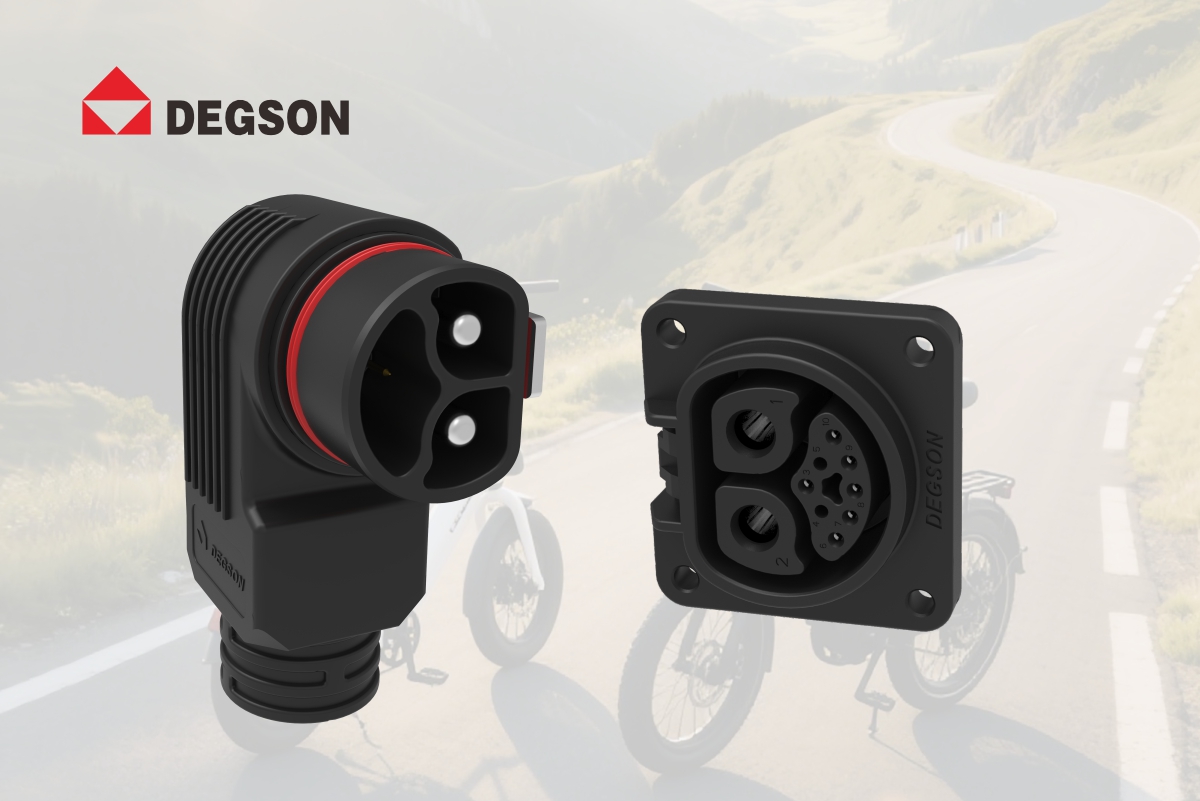
I. Typical Application Scenarios of the EBBH 80A
Scenario 1: Battery Discharge Main Line of Mid-to-High Performance Electric Motorcycles
As the 72V platform becomes the mainstream configuration for mid-to-high performance electric motorcycles, the continuous discharge current of 2000W to 3000W hub motors generally falls in the 60A to 80A range, with even higher instantaneous peaks. Whether it is frequent start-stop in urban commuting or the passenger-carrying hill-climbing conditions common in Southeast Asian markets, the power transmission from the battery pack to the controller requires a connection gateway with sufficient current margin and controllable temperature rise. The DEGSON EBBH 80A, with its 80A continuous rated current, is tailor-made for these vehicles — it minimizes power loss between the battery pack and the controller, ensuring responsive acceleration without lag, and keeping terminal temperature rise within a safe range during prolonged hill climbs.
Scenario 2: Vehicle-Side Battery Interface for Battery Swapping Operators
The battery swapping model is becoming the mainstream energy replenishment method for food-delivery riders and shared e-scooter fleets. With every swap, the connector must endure high-frequency mating cycles, while the swapping cabinet needs to instantly read battery data — SOC (State of Charge), SOH (State of Health), and temperature — through signal pins to determine whether the battery can enter the next cycle. The DEGSON EBBH 80A provides an 80A main power connection while integrating a dedicated 2A signal channel, achieving a seamless "power-on means communication-on" experience. Its mechanical life of ≥3000 cycles also fully covers the high-frequency usage requirements of battery swapping scenarios.
Scenario 3: Power Hub of Electric Three-Wheelers and Light Cargo Vehicles
Electric three-wheelers bear the heavy responsibility of passenger and cargo transportation. These vehicles are equipped with higher-power motors and higher starting currents, and they operate year-round on muddy, dusty, waterlogged unpaved roads — imposing dual demands on the connector's current-carrying capacity and protection level. The DEGSON EBBH 80A's 80A continuous current capacity provides ample margin for the heavy-load starting of electric three-wheelers, while its IP67 protection rating when mated (and IP67 on the socket side alone), combined with 72-hour neutral salt spray test certification, enables it to maintain stable contact under the relentless assault of rainstorms, mud, and dust.
II. Who Needs the DEGSON EBBH 80A More? What Pain Points Does It Solve?
Every structural and electrical engineer at an electric motorcycle OEM has experienced this dilemma: you need a connector that can carry 80A of continuous high current to match the power requirements of 2000W to 3000W motors; yet your battery compartment space is extremely limited, and you also need to reserve routing space for BMS communication, temperature sensing, and other signal lines. Most traditional solutions force you to choose between "power" and "intelligence" — either use a high-current pure-power connector and then route an additional set of signal lines, resulting in messy wiring and doubled space, or use a low-current hybrid connector that sacrifices power performance.
Even more troubling are the pain points on the assembly side: traditional thread-locking connectors require multiple steps of "align — rotate — tighten — verify," making one-handed operation difficult for line workers and reducing assembly efficiency; the lack of clear feedback after mating makes "is it plugged in tight?" the most common anxiety in production line quality inspection and after-sales maintenance, and virtual connections leading to overheating, arcing, or even fire are the quality hazards that OEMs least want to see. In the real-world operating environments of Southeast Asian rainy seasons, African dust, and Indian mud, connectors with insufficient protection ratings often develop poor contact and terminal corrosion problems within the warranty period.
The DEGSON EBBH 80A power plug and socket, purpose-designed for the battery interface of mid-to-high performance electric motorcycles, was born precisely to solve these pain points. Within a single compact housing, it simultaneously provides 80A continuous high current and a dedicated 2A signal circuit, and with its auto-locking structure, audible-visual dual feedback, IP67 full protection, and compact right-angle design, it answers the question every engineer is asking: how do you fit a battery interface that is both powerful and intelligent, both reliable and easy to use, into the limited space of a battery compartment?
III. The Difference Between the DEGSON EBBH 80A and Ordinary Power Connectors Lies in Four Key Engineering Decisions
1. Hybrid Architecture: 80A Power + 2A Signal, One Plug Does It All
Traditional designs often separate high-current power lines from BMS communication lines, using two independent connectors, resulting in messy wiring inside the battery compartment, doubled space occupation, and an additional failure point. The DEGSON EBBH 80A innovatively integrates the high-current power channel and the 2A signal channel into a single interface: the power side handles 80A continuous battery discharge, while the signal side handles real-time BMS data transmission. This not only halves wiring complexity and frees up valuable space inside the battery compartment, but also achieves a seamless "power-on means communication-on" experience — the swapping cabinet or vehicle controller can read battery status the instant the plug is inserted, without waiting for an additional signal connection step.
2. Auto-Locking + Audible-Visual Dual Feedback: Say Goodbye to Blind Mating, Eliminate Virtual Connections
"False insertion" and "virtual connection" during assembly are the leading causes of connector failure and safety incidents. The DEGSON EBBH 80A adopts an auto-locking structure design: when the plug is pushed into the socket, it automatically locks without additional rotation or pressing. When fully mated, the operator hears a clear "click" auditory feedback, while the alignment indicators on the plug and socket provide visual confirmation — this dual-confirmation mechanism eliminates the guesswork of "is it plugged in tight?" from the source, significantly reducing defect rates on the production line and misdiagnosis rates in field maintenance. Its extraction force of >50N ensures that it will not accidentally detach during riding vibration, while still making disassembly during after-sales maintenance not overly laborious.
3. IP67 Full Protection + 72-Hour Salt Spray Test: Built for the Worst Road Conditions
The operating environment of micro-mobility vehicles is far harsher than that of passenger cars: continuous rainstorms in the Southeast Asian monsoon season, dust-storm-like particulate environments in Africa, waterlogged and mud-splashed roads in India, and high-salt-mist air in coastal regions — each is an extreme test of a connector's protective capability. The EBBH 80A achieves an IP67 protection rating when mated (dust-tight, submersible in 1 meter of water for 30 minutes), and critically, the socket side alone also reaches IP67 — meaning that when the plug is not inserted, the vehicle-side socket itself can effectively block water vapor and dust intrusion, rather than relying on a rubber cap that is easily lost or ages and fails. Combined with 72-hour neutral salt spray test certification and UL94-V0 flame retardancy, the EBBH 80A effectively prevents metal terminal corrosion and housing aging in extreme environments such as coastal high salt mist, winter salted roads, and high-humidity rainy seasons, ensuring long-term contact reliability.
4. Compact Right-Angle Design + Low Bend Space: Layout Wisdom in a Tiny Space
Battery pack space is at a premium, especially in mid-to-high performance electric motorcycles where the battery compartment must also accommodate multiple components such as the BMS board, fuses, and relays — the connector's cable exit direction and bend radius directly affect the overall layout. The EBBH 80A plug adopts a 90-degree right-angle structure with a small, compact form factor, fully reducing the cable bend space requirement — compared with a straight plug, the right-angle design routes cables laterally along the battery pack surface, eliminating the need to reserve additional bend height above the battery compartment, so engineers no longer feel constrained when laying out wiring harnesses. Meanwhile, its ergonomic form factor design, combined with the quick push-pull structure, enables line workers to quickly align and complete mating even while wearing gloves or operating inside a narrow battery compartment.
IV. A Future-Ready Micro-Mobility Connection Solution
The rules of the game in the electric two-wheeler industry are being rewritten. The rise of the battery swapping model requires connectors to maintain low contact resistance under high-frequency mating while supporting smart BMS signal interaction; the evolution of fast-charging technology imposes higher requirements on connector current capacity and temperature rise control; under the smart-connected trend, more and more sensors and communication modules need to obtain stable power and signal channels through connectors. The DEGSON EBBH 80A power plug and socket is not a "me-too product," but a forward-looking layout for the next generation of mid-to-high performance electric motorcycle platforms — with its integrated "power + signal" architecture, it proactively responds to the industry's core demand for a "more powerful, more intelligent, more reliable" connection solution.
As a core product matrix member of DEGSON's E-BIKE and electric motorcycle full-vehicle connection solutions, the EBBH 80A, together with the EBBL, EBBM, EBSC, EBBR and other series, jointly covers the full-chain connection needs of "battery end — charging end — motor interface — controller interface." DEGSON relies on the simulation and testing capabilities of its triple-certified laboratories — UL-CTDP (USA), VDE-TDAP (Germany), and CNAS — to systematically optimize the terminal contact area, conductor cross-section, heat dissipation path, and sealing structure of every product, ensuring that performance parameters are traceable and verifiable.
When your design team evaluates interface options for your next vehicle project, consider adding the EBBH 80A to your comparison list. You can:
-
Contact the DEGSON sales team for datasheets and 3D models
-
Request the complete DEGSON micro-mobility connector product catalog
-
Apply for samples for real-world vehicle testing and verification
Contact Information: Website: www.degson.com
FAQ
[Category] EBIKE Connector > Product Specifications
Q1: What are the rated current and voltage of the DEGSON EBBH 80A power plug and socket? Which vehicle types are they suitable for?
A: The DEGSON EBBH 80A is a medium-to-high power connection product in the E-BIKE connector family, featuring a "power + signal" hybrid architecture that supports both power transmission and BMS communication simultaneously. The power channel has a rated current of 80A and the signal channel has a rated current of 2A, with a rated voltage of 72V DC and a withstand voltage of 1500V AC. It is suitable for battery discharge connections in mid-to-high performance electric motorcycles on the 72V platform with 2000W to 3000W motors; it also applies to battery-swapping electric two-wheelers, enabling instant reading of battery SOC/SOH/temperature data through signal pins; and it can be used for heavy-load starting power connections in electric three-wheelers and light cargo vehicles. The product has an insulation resistance of ≥100MΩ, a mechanical life of ≥3000 cycles, an extraction force of >50N, and supports both soldering and crimping terminal wiring methods. When selecting, evaluate based on system voltage, continuous discharge current, BMS signal communication requirements, and environmental conditions. If continuous current exceeds 80A or peak power is above 5kW, the EBBH 120A series is recommended.
Applicable Models: EBBH 80A Power Plug (Battery Side), EBBH 80A Power Socket (Vehicle Side) | Audience: E-motorcycle OEM Electrical Engineers, Battery PACK Engineers, Battery Swapping Operators | Last Updated: 2026-09-07
[Category] EBIKE Connector > Protection Performance
Q2: What is the protection rating of the DEGSON EBBH 80A? Can it be used long-term in Southeast Asian rainy seasons and coastal high-salt-mist environments?
A: The DEGSON EBBH 80A adopts a multi-layer sealing structure design, systematically optimized for the harsh outdoor operating conditions of micro-mobility vehicles. It achieves an IP67 protection rating when mated (dust-tight, submersible in 1 meter of water for 30 minutes), and the socket side alone also reaches IP67 — when the plug is not inserted, the vehicle-side socket itself blocks water vapor and dust intrusion without relying on easily lost rubber caps. The product passes a 72-hour neutral salt spray test, preventing metal terminal oxidation in coastal high-salt-mist and winter salted-road environments. It operates over a temperature range of -40°C to +105°C with a UL94-V0 flame retardancy rating. Insulation resistance is ≥100MΩ, withstand voltage is 1500V AC, and it complies with RoHS environmental requirements. For OEMs exporting to high-temperature, high-humidity, or high-dust markets such as Southeast Asia, India, and Africa, it is recommended to request the complete environmental adaptability test report during the selection phase and confirm derating conditions based on actual operating conditions.
Applicable Models: EBBH 80A Power Plug (Battery Side), EBBH 80A Power Socket (Vehicle Side) | Audience: Structural Engineers, Quality Engineers, Export Traders | Last Updated: 2026-09-07
[Category] EBIKE Connector > Installation Method
Q3: What tools are required to install the DEGSON EBBH 80A? What are the terminal wiring methods and wire gauge requirements?
A: The DEGSON EBBH 80A supports both soldering and crimping terminal wiring methods, allowing flexible selection based on production line processes. For crimping, use a crimping tool matched to the terminals and select the corresponding crimping die according to the "Terminal-Wire Gauge Matching Table" provided by DEGSON. For soldering, use a temperature-controlled soldering iron with a recommended temperature below 350°C and a soldering time not exceeding 3 seconds to avoid insulator deformation. The plug adopts a 90-degree right-angle structure, with cables routed laterally along the battery pack surface to reduce bend space requirements. The socket uses flange panel mounting, fixed to the vehicle-side panel with 4 M3 screws; refer to the product Datasheet for recommended panel cutout dimensions. The extraction force is >50N, and it auto-locks upon full mating with an audible "click" and visual confirmation, requiring no additional tools for mating or unmating. Before production line assembly, it is recommended to organize a 1-hour worker training session focusing on fool-proof alignment and mating feedback judgment. For high-volume production, configure crimping fixtures to ensure consistency.
Applicable Models: EBBH 80A Power Plug (Battery Side), EBBH 80A Power Socket (Vehicle Side) | Audience: Production Process Engineers, Wiring Harness Manufacturers | Last Updated: 2026-09-07
[Category] EBIKE Connector > Selection Comparison
Q4: What is the difference between the DEGSON EBBH 80A and EBBH 120A? How should I select for an electric motorcycle project?
A: The DEGSON EBBH 80A and EBBH 120A both belong to the EBBH series but have different positioning and architectures, suitable for electric motorcycle platforms of different power levels. The EBBH 80A adopts a "power + signal" hybrid architecture with an 80A power channel and a 2A signal channel, integrating BMS communication pins, making it suitable for mid-to-high performance e-motorcycles and battery-swapping vehicles requiring real-time battery status interaction. The EBBH 120A is a pure-power high-current connector with a rated current of 120A, focusing on pure power transmission for high-performance e-motorcycles with peak power above 5kW, without integrated signal channels. Both adopt a metal spring clip locking structure, IP67 protection when mated, and ≥3000 cycles mechanical life. The EBBH 80A has a rated voltage of 72V DC, while the EBBH 120A has a rated voltage of 72V DC / 500V AC; both have an extraction force of >50N. Selection principle: choose the EBBH 80A for 72V platforms with 2000W-3000W motors, 60A-80A continuous current, and BMS communication needs; choose the EBBH 120A for peak power above 5kW and continuous current exceeding 80A for pure power transmission; for conventional e-bike charge/discharge scenarios, consider the EBBL series.
Applicable Models: EBBH 80A, EBBH 120A, EBBL Series | Audience: System Architects, OEM R&D Engineers | Last Updated: 2026-09-07
[Category] EBIKE Connector > Mechanical Life & Reliability
Q5: After how many mating cycles do the contact resistance and protection rating of the DEGSON EBBH 80A remain stable? Will it detach under vibration conditions?
A: The DEGSON EBBH 80A is designed for durability in high-frequency mating scenarios such as battery swapping and after-sales maintenance. Its mechanical life is ≥3000 cycles, far exceeding the industry average. After 3000 mating cycles, the terminal contact area maintains stable low contact resistance, insulation resistance remains ≥100MΩ, and the IP67 protection rating when mated does not degrade. The product adopts an auto-locking metal spring structure upon full mating with an extraction force of >50N, preventing accidental detachment under e-motorcycle riding vibration. Upon mating, it provides a clear audible "click" and visual alignment indicator, eliminating virtual-connection-induced overheating risks at the source. The product passes a 72-hour neutral salt spray test, operates from -40°C to +105°C, and has a UL94-V0 flame retardancy rating. For battery swapping operators, it is recommended to evaluate connector replacement cycles based on daily swap frequency. For OEMs, it is recommended to include combined vibration + temperature cycling verification in real-vehicle testing to confirm long-term reliability under vehicle assembly conditions.
Applicable Models: EBBH 80A Power Plug (Battery Side), EBBH 80A Power Socket (Vehicle Side) | Audience: Reliability Engineers, Battery Swapping Operator Maintenance Teams | Last Updated: 2026-09-07


