Beyond Waterproofing: The True Gap Between Commercial and Industrial RJ45 Connectors
In most people's perception, the RJ45 network port is just an inconspicuous, basic accessory. For home and office environments, a standard network port that can plug in a cable and connect to the internet is more than enough. Many mistakenly believe that choosing a high-protection RJ45 for industrial scenarios merely adds a layer of waterproof and dustproof capability to cope with humid and dusty environments.
However, the gap between standard commercial network ports and industrial-grade RJ45 connectors goes far beyond waterproofing and dustproofing. Beneath the identical appearance and consistent wiring logic lies a total crushing superiority in stability, anti-interference capability, and environmental adaptability. For demanding applications such as industrial automation, outdoor equipment, smart manufacturing, and vehicle-mounted industrial control, this subtle hardware gap directly determines whether a device drops offline, a production line halts, data is distorted, or a system runs stably.
Daily office and home environments are temperature-controlled, clean, vibration-free, and free of electromagnetic interference—conditions where standard RJ45 ports 内部技能. These commercial ports focus on lightweight design and low cost, featuring thin plastic shells, limited latch elasticity, and a protection rating suited only for indoor, dry, and clean environments, completely lacking waterproof, dustproof, or anti-corrosion designs.
Conversely, industrial sites are never "gentle." High-frequency machine vibrations, outdoor wind, frost and rain, extreme high-to-low temperature swings, strong electromagnetic interference from motors and frequency converters, and continuous erosion by dust and oil... Under such working conditions, all the shortcomings of standard network ports are infinitely magnified: slight vibrations cause loose connections and frequent disconnections; moisture and dust intrusion lead to oxidized contacts and poor contact; electromagnetic interference triggers data packet loss and latency; and extreme cold or heat causes direct hardware failure.
When industrial equipment malfunctions unexpectedly, production lines stop for no apparent reason, monitoring data breaks, or remote control fails, root-cause analysis often reveals that the core problem is not the motherboard, system, or software, but a neglected standard network port that simply could not withstand the rigors of the industrial environment. The emergence of industrial-grade RJ45 connectors is designed to bridge all these scene vulnerabilities and achieve an all-dimensional upgrade.
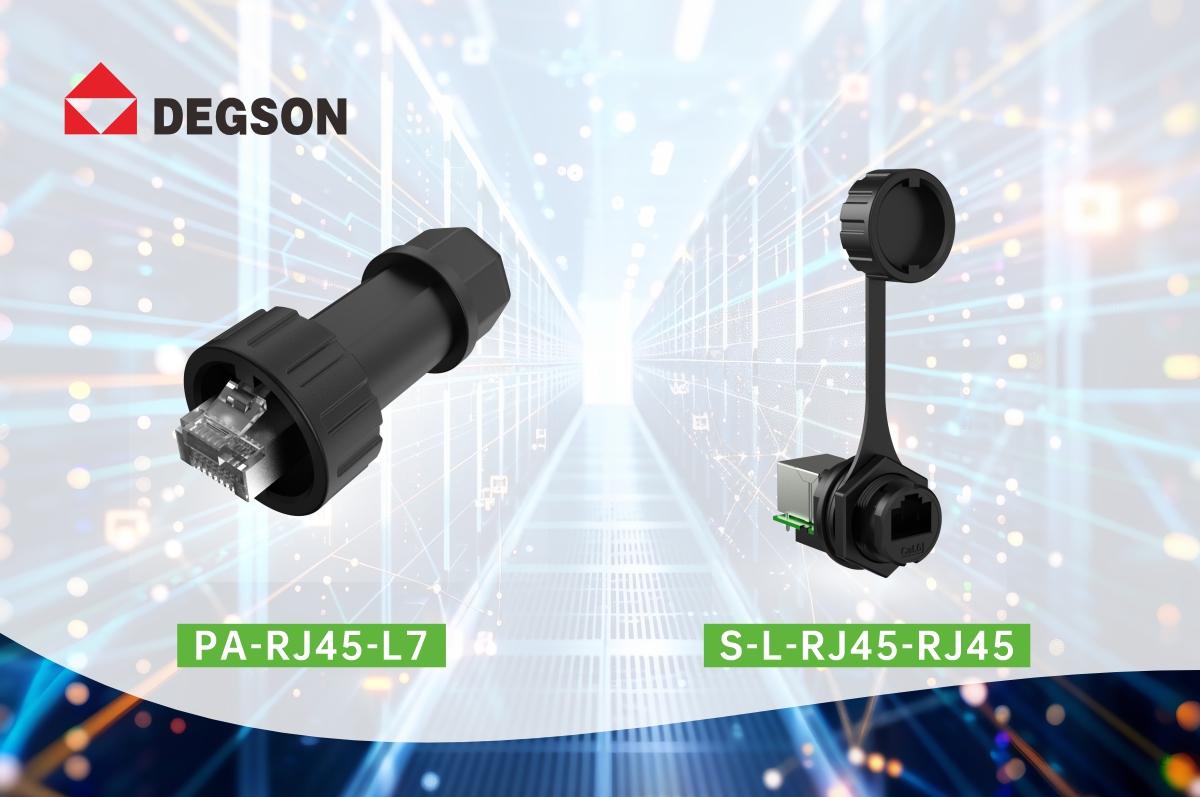
Beyond Waterproofing and Dustproofing: Hardcore Protection Secures Device Baselines
Waterproofing and dustproofing are the most intuitive advantages of industrial-grade RJ45s, yet they are only the baseline capabilities. Standard network ports lack a sealed design, allowing moisture, dust, and oil to easily invade the interior. Long-term accumulation causes metal contacts to oxidize, short-circuit, or make poor contact—a high-incidence trigger for hidden industrial equipment faults.
Industrial-grade RJ45s generally feature integrated sealing rubber rings and precision snap-fit sealing structures, with protection ratings up to IP67. They completely resist dust intrusion and stand unafraid of rain washing, stagnant water soaking, or industrial oil corrosion. Whether for outdoor base stations, outdoor surveillance equipment, damp chemical workshops, or dusty production floors, they maintain long-term cleanliness and stability, fundamentally eliminating failures caused by environmental erosion.
Anti-Vibration and Anti-Loosening: Say Goodbye to Frequent Disconnections Under Vibrations
The greatest invisible killer in industrial sites is continuous mechanical vibration. Standard commercial RJ45 latches are thin with weak clamping forces. Slight cable shaking or high-frequency equipment vibrations can cause interface virtual connections, looseness, and intermittent network dropouts or data stuttering. After frequent plugging and unplugging, standard latches easily suffer from fatigue failure, eventually losing the ability to firmly clamp the cable and requiring a replacement of the port device.
Industrial-grade RJ45s undergo targeted structural enhancements, utilizing thickened metal locking tabs and dual-locking engagement designs. Their insertion and extraction lifespan is drastically increased, ensuring tight, firm, and wobble-free fitting after latching. Even in high-vibration scenarios like machine tools, rail transit, vehicle-mounted industrial controls, and assembly line equipment, they lock cables securely in place, completely resolving vibrations-induced disconnections, packet loss, and signal instability, ensuring 24/7 continuous and stable equipment operation.
Comprehensive Anti-Electromagnetic Interference: Guarding Industrial Data Precision
Most standard network ports feature unshielded designs without metallic enclosures, leaving them completely "naked" in industrial environments. Frequency converters, servo motors, and high-voltage equipment in workshops generate massive amounts of electromagnetic radiation, easily interfering with network signals and causing data transmission delays, packet loss, or garbled text, leading to errors and failures in high-precision operations like precision industrial control, vision inspection, and data acquisition.
Industrial-grade RJ45s come standard with metal shielding shells paired with an aluminum foil plus metal braided mesh dual-layer shielding architecture. This effectively isolates external electromagnetic interference and shields transmitted signals from external noise, safeguarding the stability and integrity of Gigabit and 10-Gigabit network transmissions. Even in complex electromagnetic environments, they achieve high-speed, low-latency, and zero-packet-loss data transmission, meeting the high-precision and high-real-time demands of industrial operations.
Ultra-Wide Temperature Adaptation: Breaking Through Environmental Temperature Limits
Standard commercial network ports are only suited for room temperature environments with narrow operating temperature ranges. Extreme temperatures easily cause material deformation, contact failure, and transmission interruptions. Scorching summer outdoor heat or freezing winter cold will cause standard network port devices to fail to start properly or suffer from frequent dropouts.
Industrial-grade RJ45s adopt high-temperature and low-temperature resistant industrial-grade materials, carefully calibrated through rigorous processing to stably adapt to ultra-wide temperature ranges from -40 to 85. Whether deployed in northern freezing outdoor environments, high-temperature workshop equipment, or open-air photovoltaic and wind power monitoring terminals, they maintain stable performance unaffected by dramatic temperature swings, staying online all-weather without failure.
Lower Maintenance Costs: Maximizing Long-Term Cost-Performance
Judging by the unit purchase price, industrial-grade RJ45s are more expensive than standard network ports. However, from a long-term operation and maintenance perspective, their cost-performance ratio is worlds apart. Standard network ports are fragile, easily damaged, and prone to failure. The hidden losses caused by frequent network drops and shutdowns, equipment repairs, interface replacements, and production line halts far exceed the cost of the hardware component itself.
By virtue of their wear-resistant, corrosion-resistant, vibration-resistant, and long-life characteristics, industrial-grade RJ45s dramatically lower equipment failure rates, reduce manual O&M, repair replacement, and downtime loss costs. Through a minor hardware upgrade, they avert massive production losses, serving as the core detail for industrial equipment to reduce costs and increase efficiency.
Conclusion: Details Determine the Upper Limit of Industrial Equipment Stability
Many overlook the humble network port, unaware that it serves as the "throat" for device data transmission. Standard network ports are tailored for comfortable indoor environments, while industrial-grade RJ45 connectors are hardcore safeguards born for harsh operating conditions.
Their upgrade extends far beyond waterproofing and dustproofing; it is an all-round evolution covering structure, protection, anti-vibration, anti-interference, temperature tolerance, and lifespan. For industrial equipment, choosing a premium industrial-grade RJ45 is not over-configuration—it is a fundamental respect for equipment stability, production continuity, and data security.
This small interface upgrade safeguards the year-round stable operation of equipment and underpins the efficiency and reliability of industrial production.


