Don't Let the "Small Interface" Drag Down the "Large System" — Selection Guide for PV & Energy Storage Communication RJ45 Connectors
In the monitoring room of a photovoltaic power station, an operations engineer frowns at the flickering alarm signals on the screen — communication interrupted, inverter data lost, and fault location nowhere to be found. After a full round of troubleshooting, the problem is traced back to an inconspicuous component: the RJ45 connector.
This is not an isolated case. As integrated PV-storage systems become increasingly widespread, the stability of the communication network directly determines the power generation efficiency and operational costs of the entire plant. Yet, as the most easily overlooked link in the communication chain, the selection of RJ45 connectors often becomes the "Achilles' heel" of system reliability.
I. The Unique Demands of PV-Storage Communication: Not All RJ45 Connectors Can Handle It
Many people's impression of RJ45 connectors still lingers in office environments — plug in the network cable, and it works. But there is a vast gap between office settings and PV-storage communication scenarios.
PV inverters are typically deployed outdoors, where internal cabinet temperatures can exceed 70°C in summer and drop to -30°C in winter. The environment inside energy storage battery compartments is even harsher, with high humidity, salt spray, and dust being the norm. Communication signals must be transmitted uninterrupted 24/7 in such conditions. Any single instance of poor contact can cause Modbus TCP or SunSpec protocol communication interruptions, triggering cascading alarms. This means that RJ45 connectors used in PV-storage communications are by no means consumer-grade products that "just plug in and work." They are precision components that must meet industrial-grade reliability requirements. As the DEGSON technical team summarized in their recently launched industrial protection-grade RJ45 product series — industrial applications demand "stability" (no network interruptions), while energy applications demand "resilience" (no damage): factory floors fear machine vibration and electromagnetic interference, so selection must consider locking mechanisms and shielding layers; PV plants, wind farms, oil fields, and coal mines fear rain ingress and salt spray corrosion, so selection must feature high-grade waterproofing.
II. Five Key Selection Criteria: The Critical Leap from "Usable" to "Reliable"
1. Shielding Performance: The First Line of Defense Against Interference
PV inverters simultaneously carry strong electrical and weak signal currents. The electromagnetic interference (EMI) generated by high-frequency switching operations can easily couple into communication lines. High-quality industrial-grade RJ45 connectors should feature fully metal-shielded housings combined with 360° shielding contact design, ensuring shielding effectiveness of over 60dB even at high frequencies. Additionally, the shielding layers of the plug and socket must form a continuous low-impedance path to prevent "shielding gaps" from becoming entry points for interference.
2. Contact Reliability: Spring Design Determines Long-Term Stability
The core contact elements of RJ45 connectors typically use high-conductivity copper alloy substrates, but what truly determines long-term reliability is the geometric structure of the contact springs. The curvature radius, number of contact points, and normal force of the springs must be precisely matched — insufficient pressure leads to fretting corrosion and contact resistance drift, while excessive pressure accelerates wear and can even damage the socket.
Evaluating contact reliability requires a three-dimensional approach:
-
Structural level: Examine whether the geometric design of the contact springs is reasonable and whether the normal force has been validated through simulation and actual testing, ensuring stable contact under vibration and temperature cycling conditions
-
Parameter level: Request contact resistance vs. mating cycle curves from suppliers. Industrial-grade products should guarantee that contact resistance remains stable below 20mΩ after 1,000 mating cycles
-
Environmental level: Confirm whether the product has passed temperature cycling, damp heat, vibration, and other reliability tests
DEGSON's industrial-grade RJ45 products feature precision spring design with a mating life of ≥1,000 cycles and stable contact resistance across the full temperature range, effectively preventing communication interruptions caused by fretting corrosion. Additionally, terminal surface treatment processes (such as selective plating) must be designed in coordination with contact pressure to ensure stable metal contact under varying environmental conditions.
3. Protection Rating: IP67 Is Not "Optional" — It's "Mandatory"
RJ45 ports in outdoor cabinets must have IP67 protection capability to prevent rain and dust ingress that could cause short circuits or poor contact. This requires the connector to incorporate multiple protective features in its structural design, such as sealing rings and waterproof gaskets, and to pass airtightness testing after assembly.
It is particularly important to note that IP protection rating depends not only on the connector body but also closely on cable assembly workmanship — "connector waterproof but cable joint not waterproof" is a common misconception. DEGSON's industrial protection-grade RJ45 product series comes with complete sealing gaskets, achieving IP67 protection rating. Models such as PA-RJ45-L7 feature cable screw-locking + sealing ring design, structurally eliminating water ingress risks.
4. Environmental Endurance: Temperature Cycling Testing Is the "Touchstone"
Industrial-grade RJ45 connectors should pass temperature cycling tests from -40°C to +85°C to verify their mechanical stability and electrical performance under extreme temperatures. For coastal or offshore PV projects, salt spray testing (typically requiring over 96 hours) and UV aging resistance must also be considered.
DEGSON RJ45 products cover an operating temperature range of -40°C to 85°C, with flame retardancy compliant with UL 94 V0, and cables passing VW-1 flame retardancy. These tests are not "icing on the cake" — they are guarantees that the product can operate stably throughout the entire lifecycle of the power station.
5. Protocol Compatibility: Don't Let the Physical Layer Become a Communication Bottleneck
As PV-storage systems evolve toward greater intelligence, communication speeds are upgrading from 10/100Mbps to 1000Mbps. The crosstalk (NEXT, FEXT) and return loss metrics of RJ45 connectors directly impact high-speed signal integrity. When selecting connectors, it is necessary to confirm whether they meet Cat 5e or Cat 6 performance grades and to conduct eye diagram testing in actual cabling environments to ensure sufficient signal quality margin.
DEGSON's industrial protection-grade RJ45 offers Cat5E Gigabit / Cat6 / Cat6A 10-Gigabit specifications:
-
Cat5E: Standard Gigabit 1000Mbps stable transmission
-
Cat6: Upgraded anti-crosstalk performance
-
Cat6A: Full-distance stable 10-Gigabit transmission
Furthermore, DEGSON conducts Fluke DSX series network analyzer certification testing on finished RJ45 products sampled from the production line, testing wire sequence, insertion loss, return loss, crosstalk, and other parameters at 100MHz frequency according to Cat5E standards, with PASS results. Retention force testing shows the products can withstand 195N axial pull force with the connection structure remaining intact — delivering on the promise that "the physical layer will not become a bottleneck" with actual measured data.
III. DEGSON's Solution: Building "Reliability" into Every Detail
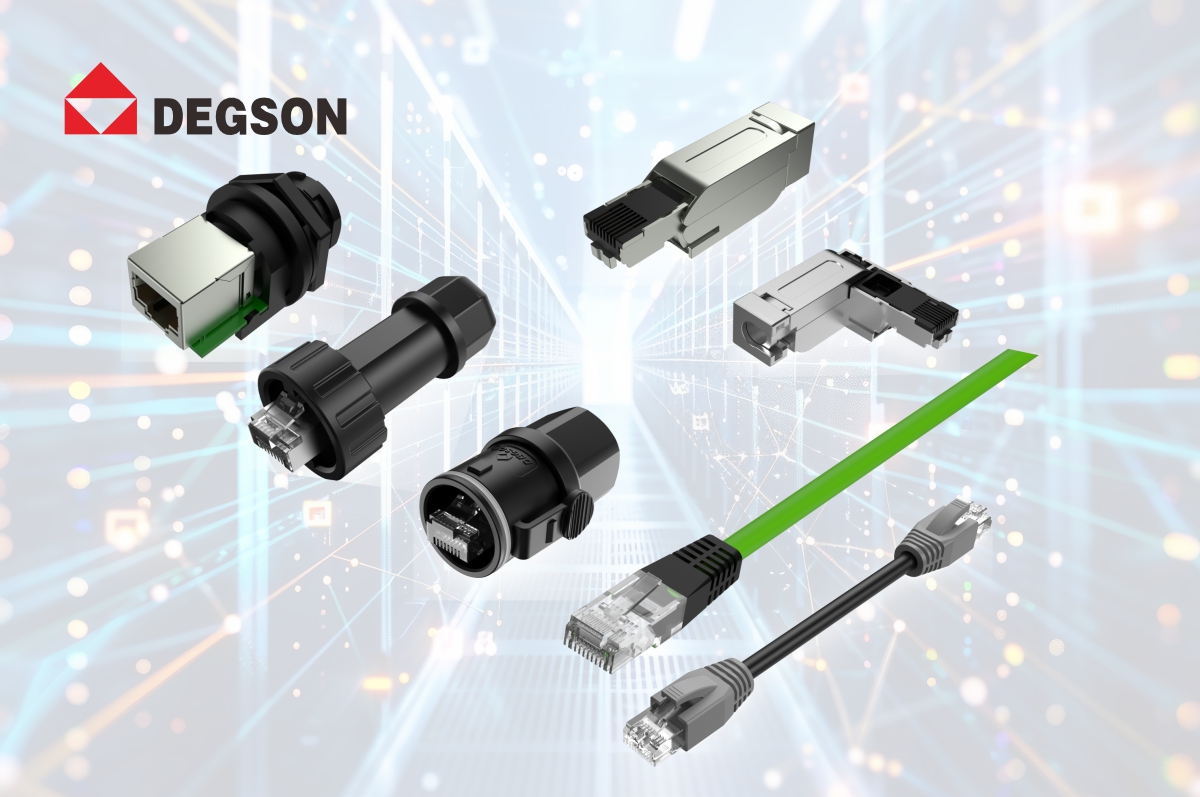
As a technology company deeply rooted in the industrial connectivity field, Ningbo DEGSON Technology Co., Ltd. has accumulated extensive engineering experience in PV-storage communication connectors. To address the two typical needs of PV-storage scenarios — "uncertain on-site cable lengths" and "one-stop pre-assembled cable harness delivery" — our industrial protection-grade RJ45 connector product series offers four major categories for flexible coverage:
Category 1: Field Wiring Series (for scenarios with uncertain cable lengths / requiring on-site selection)
-
PA-RJ45-L7: Cable screw-locking with sealing ring for waterproof and dustproof protection — the first choice for high protection
-
S-L-RJ45-RJ45: Multiple tail-end connection options, including 180° PCB RJ45 socket / 90° PCB RJ45 socket / 8P terminal and other interfaces
Category 2: Pre-Assembled Cable Series (cable harness + connector one-stop service)
-
No on-site processing required; threaded and snap-lock versions available; cable lengths fully customizable
-
Crimp-free design — no crimping tools needed, quick on-site assembly; full metal shielding
-
Right-angle versions fit tight cabling spaces; angled versions reduce hard bending of network cables
-
Cat5E/Cat6/Cat6A specifications available; PVC/PUR cable materials optional
Category 3: Panel Feed-Through Female Socket
Suitable for panel penetration installation in inverters and energy storage battery compartments, with IP67 high protection.
Category 4: Tool-Free Assembly Modular Plug
Metal crimp-free modular plug requires no crimping tools — wiring can be done by hand, significantly saving on-site installation time.
Two Practical Selection Tips
Booted vs. Overmolded:
-
Booted: Economical pricing with adequate basic protection
-
Overmolded: Preferred choice for tight installation spaces with superior connection performance
FUTP vs. SUTP Cables:
-
FUTP (preferred): Strong anti-interference, flexible, space-saving
-
SUTP: High mechanical strength, bend-resistant, excellent tensile strength
More importantly, we provide full-process technical support from connector selection and cable matching to installation guidance, helping customers avoid potential communication risks at the system design stage.
IV. Small Connector, Big Responsibility
In the vast architecture of PV-storage systems, the RJ45 connector is indeed just a "small component." But it is precisely these small components that form the physical foundation of the communication network. Choose correctly, and the system runs silently in the background, unnoticed; choose incorrectly, and operations personnel scramble on-site while plant revenue continues to drain away.
There is no "silver bullet" in connector selection, but there is a methodology — understand the application scenario, define performance requirements, and verify key metrics. By approaching selection from four dimensions — operating environment (choose IP67 high-protection models for outdoor high-dust and high-moisture conditions; economical IP20 booted models for indoor cabinets), installation method (choose field-assembly types for uncertain cable lengths; pre-assembled cables for defined lengths), installation space (180° straight connectors for standard connections; 90° angled connectors for limited cabinet space; panel-mount for through-panel installation), and transmission requirements (Cat5E for standard Gigabit; Cat6A for 10-Gigabit industrial networks) — most communication risks can be avoided at the very starting point of system design.
We hope this article provides a practical reference for engineers and procurement professionals working on PV-storage system design. For more technical details about industrial-grade RJ45 connectors or to request samples, please contact DEGSON — we look forward to working with you to support the future of clean energy with reliable connections.


