Don’t Let Standard Gaps Delay Your Global Launch-EV High-Voltage Connector Standards: Europe vs. America vs. China
As electric vehicle platforms roll out globally, OEMs often need to adapt high-voltage connection system designs for different regional markets. The three dominant standard systems — European LV215, North American USCAR, and Chinese GB/T — differ significantly in system positioning, test logic and parameter requirements. Misjudging these differences can lead to redundant development, certification delays and compliance risks. For engineering and procurement teams, clarifying the core gaps between the three standards is the first critical step to achieving global platform commonality and reducing development costs.
1. System Positioning and Scope of Application
Each standard system was born from different industry backgrounds and serves different core regulatory objectives.
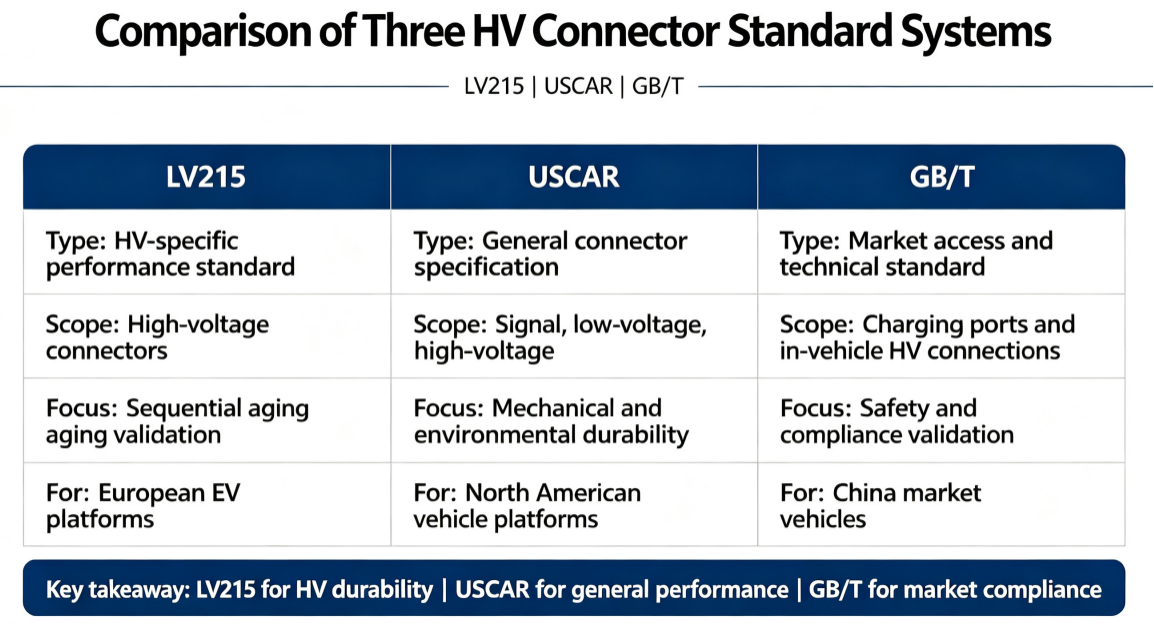
LV215, led by the German Automotive OEM Working Group, is a performance standard specifically developed for automotive high-voltage connectors, and serves as the de facto entry benchmark for European automakers. It focuses exclusively on high-voltage power connection scenarios, with detailed requirements for insulation safety, current carrying performance and high-voltage specific reliability.
USCAR, published by the United States Council for Automotive Research, was originally developed for low-voltage signal connectors and later extended to high-voltage applications. It is the general performance specification for the North American market, with a stronger focus on mechanical durability and environmental adaptability across the full vehicle connector portfolio.
The GB/T system, issued by Chinese national standardization authorities, covers general requirements, interface dimensions and performance tests for electric vehicle conductive charging and high-voltage connectors. It has the dual attributes of market access regulation and product technical specification.
2. Test Logic and Validation Process Differences
The most fundamental gap between the standards lies in test sequence and sample requirements.
LV215 requires all 30+ test items to be performed sequentially on the same set of samples, simulating the full life cycle aging of the vehicle. This is one of the most stringent validation logics in the industry, as each test applies additional stress to the already aged sample. Passing LV215 almost always requires multiple design iterations.
USCAR relies primarily on independent tests, with a strong focus on environmental durability including mechanical vibration, thermal cycling, salt spray and mechanical shock. While it also covers electrical performance, the high-voltage specific validation depth is relatively lower than LV215.
The Chinese GB/T system integrates the characteristics of both. It includes sequential aging verification similar to LV215, and also adds interoperability tests specific to charging interfaces that are not covered by the other two standards.
3. Key Technical Parameter Requirement Gaps
The differences in test logic translate into measurable gaps in key technical specifications, especially for 800V class high-voltage platforms.
In terms of creepage distance and clearance, LV215 sets stricter requirements for 800V systems under pollution degree 2 conditions, reflecting Europe's higher emphasis on high-voltage insulation safety. USCAR requirements are relatively more lenient on basic insulation dimensions but impose stricter vibration and shock profiles that match North American driving conditions.
For withstand voltage testing, LV215 requires higher test voltages for the same rated voltage class and specifies testing at both room temperature and maximum operating temperature. USCAR focuses more on room temperature withstand performance.
For safety functions, both LV215 and GB/T explicitly require verification of High-Voltage Interlock (HVIL) performance after environmental aging, while USCAR addresses HVIL at the system level rather than the component level.
4. Sourcing Implications for Global Vehicle Platforms
For OEMs developing global vehicle platforms, the most cost-effective strategy is to select high-voltage connector suppliers that natively design for all three major standards simultaneously. This allows the same product platform to be used across multiple regional markets, reducing redundant tooling, validation and certification costs.
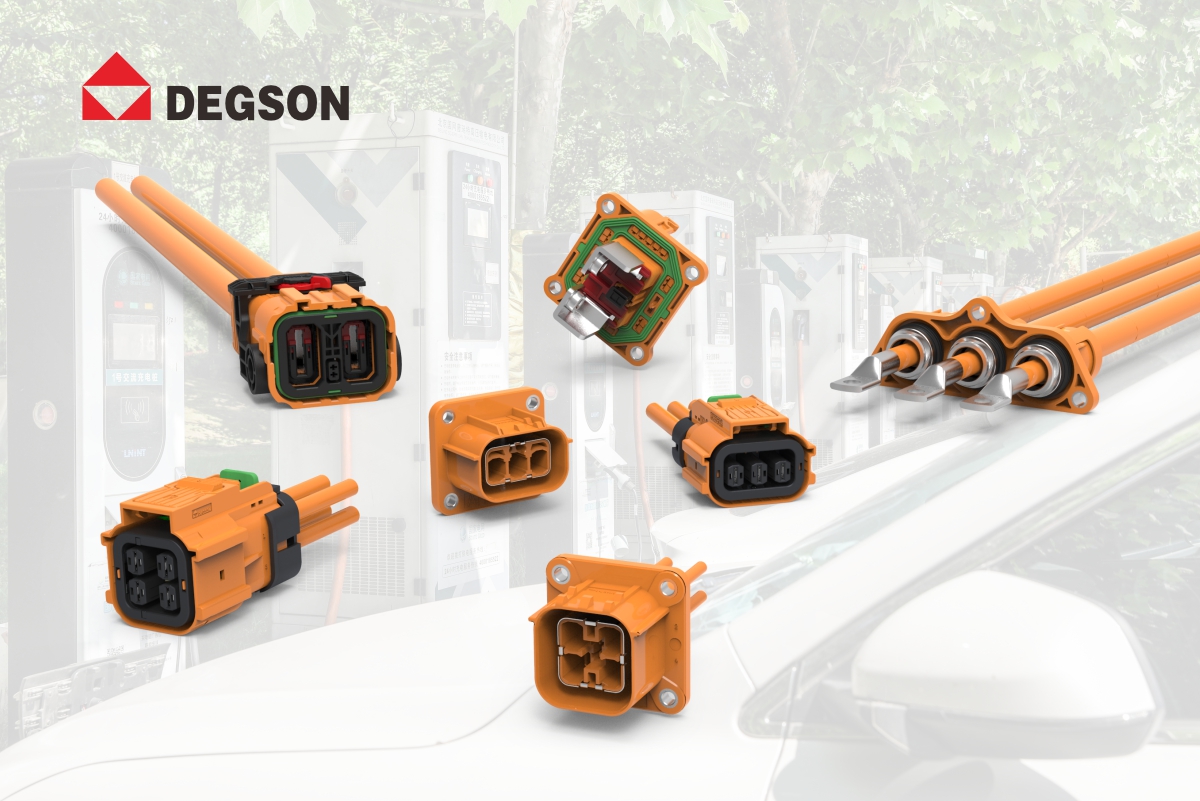
DEGSON's full portfolio of electric vehicle high-voltage connectors and charging inlets is designed from inception to align with LV215, USCAR and GB/T standard systems. All products go through full sequential validation in DEGSON's in-house accredited laboratories, enabling a single product platform to adapt to European, North American and Chinese markets. This helps OEMs maximize platform reuse rates and shorten global launch cycles.
In summary, understanding regional standard differences is critical for global electric vehicle programs. Working with a supplier that masters all three systems eliminates compliance risks and reduces total program cost. As 800V architectures become the global norm, the value of this multi-standard native design approach will only continue to grow.
References
1.LV 215-1:2017. High-Voltage Connectors for Motor Vehicles – General Requirements and Test Methods. German Automotive OEM Working Group (LV).
2.SAE USCAR-2 Rev.7:2020. Performance Specification for Automotive Electrical Connector Systems. United States Council for Automotive Research (USCAR).
3.GB/T 37133-2018. Technical Specifications for High-Voltage Connectors of Electric Vehicles. Standardization Administration of China (SAC).
About the Author
The DEGSON automotive product management team specializes in high-voltage connection solutions for electric vehicles, with deep expertise in multi-region standard compliance and IATF 16949 quality system implementation. The team supports global OEMs and Tier 1 suppliers in building safe, reliable and cost-effective high-voltage powertrain architectures.


