Charging connectors are not universal. Electric vehicles charge through four regional interface families: GB/T 20234 in China, SAE J1772 with CCS1 and NACS in North America, SAE J1772 plus CHAdeMO in Japan, and IEC 62196 Type 2 with CCS2 in Europe. Selecting a charging cable therefore starts with one question — which region will the vehicle charge in? — and only then moves to the second: what AC or DC current rating does the application need?This guide covers AC and DC charging connectors and cables for passenger EVs, and applies to home chargers, portable chargers and commercial charging stations in those four regions. It does not cover wireless charging, or the Megawatt Charging System (MCS) still under development for heavy trucks, where the connector geometry and communication protocol are governed separately.The table below maps the regional standards; the sections that follow explain what drives each one, and the final section covers how to match a cable rating to it.
|
Region
|
AC connector
|
DC connector
|
Voltage / current
|
Max power
|
|
China
|
GB/T 20234.2 (7-pin)
|
GB/T 20234.3 (9-pin)
|
AC 220/380 V, 10–63 A; DC 750/1000 V, 80–250 A
|
AC ~40 kW; DC ~250 kW
|
|
North America
|
SAE J1772 (5-pin)
|
CCS1 combo / NACS
|
AC 110/240 V to 80 A; DC 480–1000 V to 400 A
|
NACS to 1000 kW
|
|
Japan
|
SAE J1772
|
CHAdeMO
|
1.0: 500 V/125 A; 2.0 to 400 kW; 3.0 (ChaoJi) 600 A/1.5 kV
|
62.5 kW to ~900 kW
|
|
Europe
|
IEC 62196 Type 2 (7-pin)
|
CCS2 combo
|
AC 230 V 1φ / 400 V 3φ; DC to 1000 V
|
AC ~43 kW; DC ~350 kW
|
China unified the AC and DC interfaces under GB/T 20234 in 2015On 28 December 2015, China published the national standard GB/T 20234-2015, Connection devices for conductive charging of electric vehicles, replacing the 2011 edition. It has three parts: GB/T 20234.1 general requirements, GB/T 20234.2 the AC charging interface, and GB/T 20234.3 the DC charging interface. The full text of each part is available through the SAC national standards portal. Part 2 was subsequently revised, and current DEGSON AC assemblies are declared against GB/T 20234.2-2023 — worth checking on any datasheet, because a "GB/T compliant" statement without an edition year does not tell you which revision was tested.A supporting policy, the Implementation Plan for the New National Standard on EV Charging Infrastructure Interfaces (Fa Gai Neng Yuan [2016] No. 2668), required that from 1 January 2017 all newly installed charging infrastructure and newly produced EVs comply with the new standard. That deadline is why compatibility is rarely a field problem in China today: vehicle inlets, charging stations and accessories were aligned on a single interface within roughly one year.
Most Chinese EVs carry both an AC and a DC inlet; only entry-level AC-only models, such as the Wuling Hongguang MINI EV, use a single AC port. The two inlets are physically distinct and differently shaped, so they cannot be cross-inserted — a mechanical safeguard rather than a software interlock.
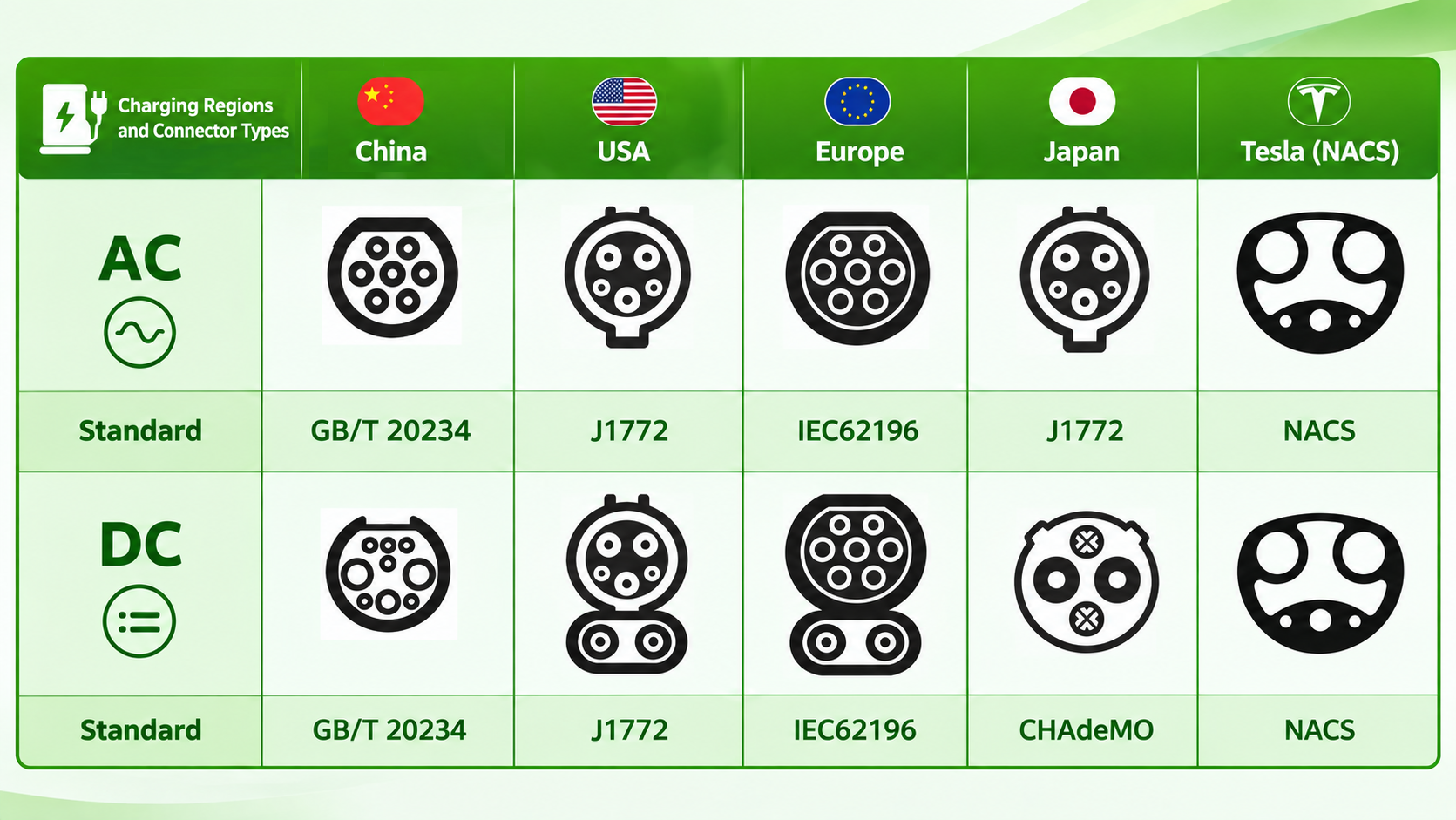
The GB/T AC inlet uses a 7-pin layout: CC and CP handle connection confirmation and control pilot, N is neutral, L is the live line (three positions available), and the centre pin is protective earth. In a typical 220 V single-phase installation only one live position is used. Chinese residential supply is 220 V/50 Hz single-phase or 380 V/50 Hz three-phase, so AC chargers are rated 10 A / 16 A / 32 A (2.2 kW / 3.5 kW / 7 kW) single-phase, and 16 A / 32 A / 63 A (11 kW / 21 kW / 40 kW) three-phase.The GB/T DC inlet uses a 9-pin layout: CC1 and CC2 confirm the connection, S+ and S− carry the CAN communication link between the off-board charger and the vehicle, the two large DC+ and DC− pins deliver the main charging current, A+ and A− supply low-voltage auxiliary power, and the centre pin is earth. DC charging is rated at 750 V or 1000 V with currents of 80 A / 125 A / 200 A / 250 A, reaching approximately 250 kW.North America runs three interfaces in parallel through the NACS transitionNorth America has the most fragmented interface landscape of the four regions, because two families are in active use at once: the SAE J1772 and CCS1 combo family, and Tesla's NACS (North American Charging Standard).SAE J1772, first published in 1996, was the first EV charging interface deployed in the United States. It targets AC charging with a single-phase, 5-pin mechanical design. The CCS1 combo connector extends it downward: the J1772 portion retains the connection-confirmation, control-pilot and ground terminals, while two added CCS pins carry DC power only. That shared-upper-half arrangement is why a CCS1 vehicle inlet also accepts a plain J1772 AC plug.Charging equipment in the US and Canada is commonly grouped into four classes: L1 (110 V AC, slow) and L2 (240 V AC, up to 80 A, typical for commercial and home installations) on the AC side; L3 and L4 (480–1000 V DC, up to 400 A) for DC fast charging.
NACS first appeared on Tesla vehicles in 2012 as a proprietary interface. In 2022 Tesla published the specification for open use, and it has since been standardised as SAE J3400. NACS is mechanically more compact than CCS1 because it uses the same two pins for AC and DC rather than adding a separate DC pair; it supports 500 V and 1000 V classes and is rated up to 1000 kW at the connector. General Motors, Ford, Volvo, Mercedes-Benz, Toyota, Polestar and Rivian have announced adoption, and Mercedes-Benz has stated its charging network will offer both CCS1 and NACS plugs. For the foreseeable future, both families will coexist — which means a North American cable decision is a decision about which vehicle fleet the equipment must serve, not simply which standard is newer.

Japan keeps CHAdeMO for DC while following J1772 on ACJapan keeps its AC and DC charging interfaces fully independent. AC charging uses the same SAE J1772 standard as North America; DC charging uses the Japan-originated CHAdeMO interface, maintained by the CHAdeMO Association.The name is a contraction of "CHArge de MOve", itself a play on the Japanese phrase o-cha demo ikaga desu ka — "how about a cup of tea?" — the point being that a charge takes about as long as a tea break. Development began in 2005, and the association's membership includes Tokyo Electric Power, Nissan, Mitsubishi, Subaru, Toyota, Honda and Panasonic.Mechanically, the CHAdeMO connector places the two large power pins at left and right, with four smaller communication pins set inside the two large circular openings at top and bottom, plus an anti-reverse feature on the rim. Communication runs over CAN, which is one of the substantive differences from CCS — CCS uses power-line communication over the control pilot instead, and the two are not protocol-compatible even where an adapter makes them mechanically mateable.CHAdeMO 1.0 supports up to 500 V / 125 A (62.5 kW). CHAdeMO 2.0, released in 2018, extends this to 400 kW. Also in 2018, the association and the China Electricity Council began joint development of CHAdeMO 3.0, named ChaoJi, which uses a completely different connector geometry and targets roughly 900 kW (600 A × 1.5 kV) — notable because it is designed for forward compatibility with GB/T through an adapter, making it the one active attempt to converge two of these four families.Europe pairs IEC 62196 Type 2 with CCS2, and neither crosses to North AmericaEurope's charging standard is IEC 62196, proposed in 2009 by the German connector manufacturer Mennekes and adopted by the EU in 2013 as the AC charging interface. The Type 2 connector uses a 7-pin layout — three line conductors, neutral, protective earth, proximity pilot and control pilot — which is what allows it to carry three-phase AC and reach approximately 43 kW, well above the single-phase ceiling of J1772.
For DC fast charging, Europe took the same combo approach as North America: CCS DC power pins are added below the Type 2 inlet, sharing the connection-confirmation, control and ground terminals, with the added pins carrying DC power only. Maximum DC power is approximately 350 kW.

Both regions use combo connectors, but the AC pin geometry and grid voltage differ — 230 V single-phase and 400 V three-phase in Europe, versus 110 V and 240 V single-phase in North America. Hence the naming: the North American connector is CCS Type 1 (CCS1) and the European one CCS Type 2 (CCS2). The two are not compatible and cannot be interchanged, despite the shared "CCS" label — the single most common cross-market specification error in this category. Some European sites also deploy CHAdeMO alongside Type 2, adding further mixed-standard variety at the station level.Matching a cable to the region and the current ratingThe selection sequence is two steps, in this order. First fix the region, because it determines connector geometry and is not negotiable. Then fix the current rating from the application: for AC, the lower of the vehicle's onboard charger rating and the supply circuit; for DC, the station's output class.Interface standards are regional, and the same vehicle sold into different markets is fitted with different inlets. China, the world's largest EV market, has had a unified interface since 2015, so compatibility is rarely a concern there. Europe, North America and Japan remain mixed, with old and new standards running in parallel — for those markets, confirm the installed base at the specific site rather than assuming the regional standard.Against that sequence, DEGSON's charging cable series map to regions as follows:
|
Region / standard
|
Series
|
Ratings
|
Typical application
|
|
China, GB/T AC
|
MGAC-S-010A / 016A-V21B-03-5.0M
|
10 A / 16 A
|
Portable charger, integrated PCBA control, household socket
|
|
China, GB/T DC
|
MGDC-T-125A / 200A / 250A-V23-03-5.0M
|
125–250 A
|
Vehicle connector with free cable end, DC fast-charging station
|
|
North America, NACS AC
|
MTAC-S-016A/032A/040A/048A-V3, MTAC-S-065A/080A-V5
|
16 A–80 A
|
Portable, home and commercial AC chargers
|
|
North America, NACS DC
|
MTDC-S-150A/200A/250A/350A-V5-03-5.0M
|
150 A–350 A
|
Commercial DC stations; 350 A to 350 kW at 1000 V
|
|
North America, J1772
|
MADC-S-040A
|
40 A AC
|
Home and commercial AC charging stations
|
|
Europe, Type 2 AC
|
MEAC-S-016A/032A-V1, MEAC-T-032A-V1, MEAC-S-016A-V1P1
|
16 A / 32 A
|
Station-side cable; V1P1 is a mobile cable with both vehicle connector and infrastructure plug
|
|
Europe, CCS2 DC
|
MEDC-T-020A/040A/065A/080A-V21, plus high-power 200 A–380 A
|
20 A–380 A at 1000 V
|
Wall-box through high-power DC station
|
|
Japan, CHAdeMO
|
—
|
—
|
No CHAdeMO product currently available
|
Two boundaries are worth stating plainly. The Chinese AC assemblies (MGAC series) integrate the control circuitry in the plug and are declared to GB/T 20234.2-2023, with IP67 unmated / IP55 mated and an operating range of −30 °C to +55 °C — they plug into a household socket, so they suit retail and home charging rather than commercial installation. And the North American DC series (MTDC) is declared against SAE J3400 and UL 2251, which is the pairing to check on any NACS tender: J3400 governs the interface, UL 2251 governs the plug, socket-outlet and coupler as safety-rated hardware.
Across the DC series, the published construction features are dual PT1000 temperature sensors in the connector, UL94 V-0 flame-retardant housing materials, and cable flexibility rated to −20 °C. Mechanical endurance and insertion force are deliberately not quoted here: a mating-cycle count means something only alongside the standard it was tested to, and where either figure is a contractual requirement, request the test report covering the exact part number.Q1: Can I use a charging cable from one region in another?Not directly. The connector geometries differ — the GB/T 7-pin AC inlet, Type 2 and SAE J1772 are not interchangeable, and CCS1 and CCS2 are incompatible despite the shared name. Beyond geometry, CHAdeMO and CCS also use different communication protocols (CAN versus power-line communication), so mechanical adaptation alone does not make them interoperable. AC adapters do exist for some pairings, but confirm standard compliance and local regulations before using one; the reliable approach is to select the cable series built for the region.Q2: How do I pick the right current rating once the region is fixed?Start from the application, not the connector's maximum. For AC home or portable charging, match the rating to the lower of the vehicle's onboard charger and the supply circuit — 10 A / 16 A / 32 A single-phase, up to 80 A in North America. For DC fast charging, match the cable to the station's output class: 125–250 A for GB/T, 150–350 A for NACS, and up to 380 A for European high-power DC. Rating a cable above the circuit adds cost and stiffness without adding charging speed, because the vehicle's battery management system, not the cable, sets the actual current.
-
GB/T 20234.1 / 20234.2 / 20234.3 — Connection devices for conductive charging of electric vehicles. Standardization Administration of China. Full text: openstd.samr.gov.cn
-
Implementation Plan for the New National Standard on EV Charging Infrastructure Interfaces, Fa Gai Neng Yuan [2016] No. 2668. National Development and Reform Commission.
-
SAE J1772 — SAE Electric Vehicle and Plug-in Hybrid Electric Vehicle Conductive Charge Coupler. SAE International
-
SAE J3400 — NACS Electric Vehicle Coupler. SAE International
-
IEC 62196 series — Plugs, socket-outlets, vehicle connectors and vehicle inlets — conductive charging of electric vehicles. IEC Webstore
-
CHAdeMO protocol and ChaoJi (CHAdeMO 3.0) specifications. CHAdeMO Association
Before specifying a charging cable, confirm two things in order: the regional standard the vehicle inlet follows, and the current rating the circuit actually requires. With both fixed, the series follows directly from the mapping table above. To evaluate DEGSON charging cables against these standards, browse the charging connector series on degson.com and download the datasheet for the exact part number — or contact DEGSON application engineering to request test reports and samples for the model and cable length you intend to deploy.


